Research / Gold Fold Terminal
Members' tool
Gold against the yen, on one screen
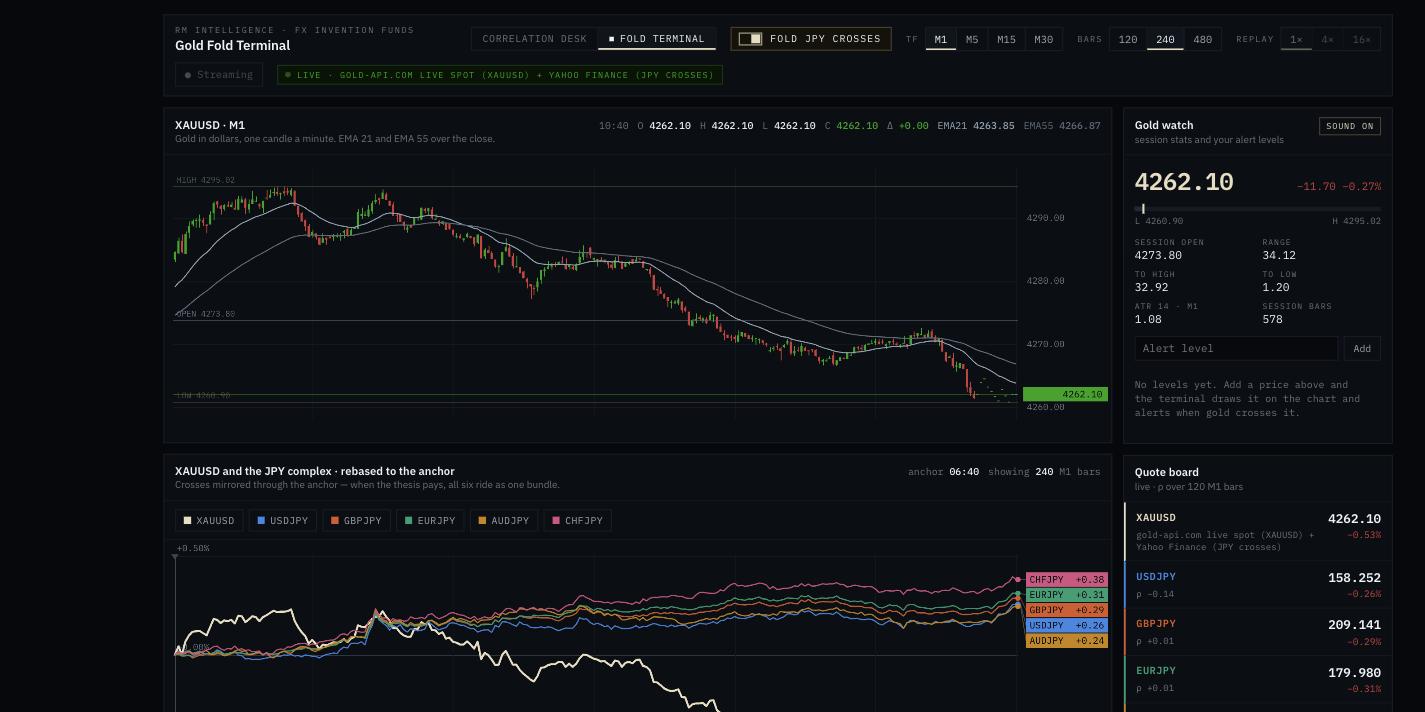
The Gold Fold Terminal charts spot gold (XAU/USD) minute by minute next to the five main yen crosses, all rebased to the same starting point. You can see at a glance whether gold is moving with the yen complex or breaking away from it.
Today's gold–yen correlations
Correlation of daily returns between gold and each yen cross. Values near +1 mean they tend to move together, near −1 in opposite directions, and near 0 independently. Built from 500 daily closes.
| Yen cross | 20-session correlation | 60-session correlation | 5-session change |
|---|---|---|---|
| USD/JPY | +0.49 | +0.19 | +0.09% |
| GBP/JPY | +0.32 | +0.20 | +0.32% |
| EUR/JPY | +0.42 | +0.25 | -0.22% |
| AUD/JPY | +0.35 | +0.22 | +0.51% |
| CHF/JPY | +0.31 | +0.16 | -0.03% |
| XAU/USD (gold) | — | — | +1.30% |
Why watch gold against the yen?
Gold and the Japanese yen are both treated as safe havens, and both are sensitive to real interest rates and US dollar strength. When global yields fall or risk appetite weakens, gold and the yen often strengthen together. With yen crosses quoted as foreign currency per yen, that shows up as the crosses falling while gold rises. When that relationship breaks, it can be a sign that something specific to gold (central-bank buying, physical demand) or specific to Japan (Bank of Japan policy) is driving the move.
Plotting all six instruments from a common anchor makes those divergences visible within minutes instead of after the close.
What the terminal shows
- Live XAU/USD candles: one-minute candles built from gold-api.com live spot, with EMA 21 and EMA 55. Switch between M1, M5, M15 and M30, showing 120, 240 or 480 bars.
- The fold view: gold and USD/JPY, GBP/JPY, EUR/JPY, AUD/JPY and CHF/JPY rebased to the same anchor time, with an option to mirror the crosses so moves in the same "safe-haven" direction line up.
- Quote board: live price, daily change and the rolling correlation (ρ) of each cross with gold.
- Gold watch: session open, high, low, range, distance to each extreme, ATR, and your own alert levels drawn on the chart with a sound when gold crosses them.
The conditional long / short playbook
These are the rules the RM Intelligence desk and research copilot use to decide whether gold is a conditional long, a conditional short or a wait. Every condition in a step has to pass before moving to the next one. If any step fails, the answer is WAIT.
- Trend (daily close vs 20/50-day averages): headwind
- US dollar (DXY vs its 20-day average): headwind
Step 1 · Daily regime filter (decides the direction)
| Filter | Long (buy) needs | Short (sell) needs |
|---|---|---|
| Trend | Daily close above both the 20-day and 50-day averages | Daily close below the 50-day average |
| US dollar (DXY) | Below its 20-day average | Above its 20-day average |
| Real yields (US 10-year TIPS) | Falling or flat over the last 5 sessions | Rising or flat over the last 5 sessions |
| RM macro model | Not "rich" (residual z-score below +1.5) | Not "cheap" (residual z-score above −1.5) |
If the trend, dollar and model filters don't all point the same way, do not trade. Mixed filters are the most common state, and waiting is part of the method.
Step 2 · Yen confirmation (this terminal)
- Long: at least 3 of the 5 yen crosses are below the anchor (the yen is strengthening) while gold is above it. Safe-haven demand is lining up.
- Short: at least 3 of the 5 crosses are above the anchor (the yen is weakening, risk-on) while gold is below it.
- If the yen and gold disagree, halve the planned size or skip the trade. Set the anchor to the start of the current session (for example the London open).
Step 3 · Entry trigger (H1 or M15 chart)
- Break: a candle closes above the most recent swing high (long) or below the most recent swing low (short). A wick alone does not count.
- Retest: price comes back to the broken level and holds. No candle closes back through it.
- Confirm: a completed candle closes in the trade's direction off the retest. Enter at that candle's close.
- Don't chase: if price is already more than one M15 ATR beyond the breakout level, skip it and wait for the next setup.
Step 4 · Stop, target and exit
- Stop: beyond the structure that would prove the idea wrong, i.e. below the retest low for longs or above the retest high for shorts. As a sanity check, the stop should be at least about 0.8 × ATR(14) on H1. If it has to be tighter, the setup is too noisy.
- Target: the trade must offer at least 1.5R (1.5 × the risk) after spread and costs, and 2R is preferred. Use the next swing or the session high/low as the target. If that is closer than 1.5R, skip.
- Managing it: move the stop to break-even at +1R. Never widen a stop after entry.
- Exit early if the daily close crosses back through the 20-day average against the position, or if the Step 1 regime flips.
Risk limits (always on)
- Risk 0.25%–0.50% of account equity per trade. Position size = risk amount ÷ (stop distance × contract value), using your broker's exact contract size.
- Maximum daily loss 1% of equity. Stop trading for the day after two consecutive losses.
- No more than one open gold position in the same direction at a time.
Do not trade when…
- 30 minutes either side of high-impact US releases: CPI, non-farm payrolls, FOMC decisions and Fed chair speeches.
- The spread is more than twice its usual level, or the market is gapping.
- The live price is stale or any data source shows as unavailable on the status page.
- During the daily rollover (roughly 21:00–23:00 UTC) or the last hours before the weekend close.
Where the data comes from
- Gold: gold-api.com live spot for the current price and the latest minutes, with COMEX gold futures candles adjusted to the spot level for older history. RM Intelligence's MT5 broker feed takes over automatically when it is running.
- Yen crosses: Yahoo Finance public FX rates.
- Every price is a reference quote, not an executable broker price. The terminal is a research tool and cannot place orders.
See membership options · Today's free XAU/USD macro report · XAU/USD AI copilot